
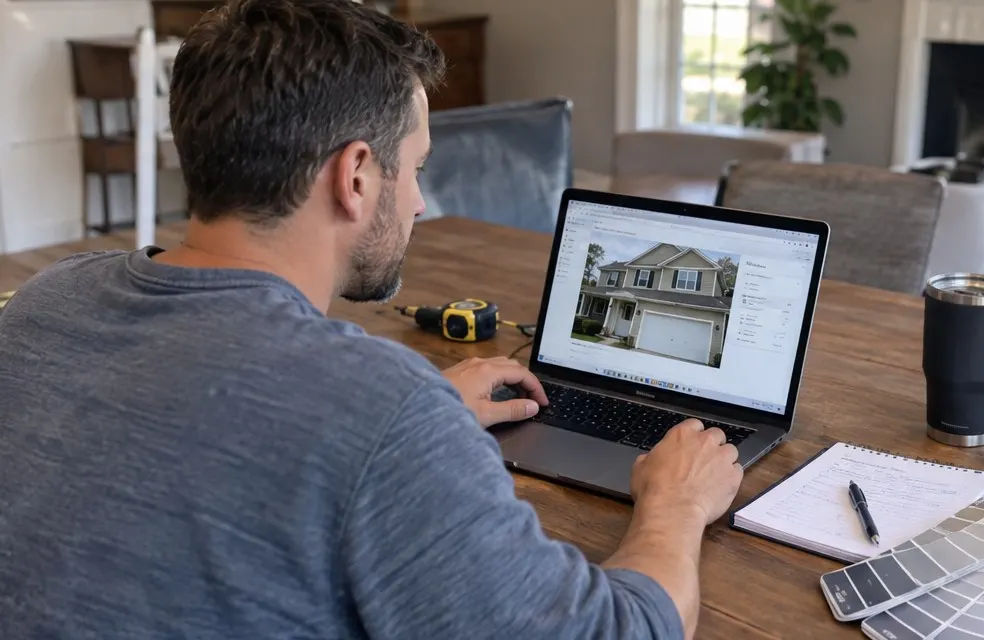
Count the estimate visits you did last month and how many turned into jobs. For many painters it is one in three or worse. Each visit costs an hour to two hours with the drive. If you do 15 a month and close 5, you spent 10 evenings on people who were never going to hire you.
Why painting estimates go nowhere
- The homeowner wanted a number to compare, not a painter
- Their budget was half of what the job costs
- They got three quotes and picked the cheapest
- Nobody followed up
You cannot fix all of that, but you can stop paying for it with your evenings.
Step 1: Give a range before the visit
Most homeowners can tell you the rooms, or the square footage of the house, without you being there. Turn that into a range from your own rates:
- Interior: a base charge plus a rate per room, plus ceilings, trim and repairs
- Exterior: a base plus a rate per square foot of the home, plus pressure washing, stucco repair, fascia
- Cabinets: a base plus a rate per door
- Fences and decks: a rate per linear foot, plus stain or repairs
A calculator on your website does this at 10 p.m. without you. The homeowner who sees "$1,700 to $1,900 for three bedrooms with ceilings" and still books a walkthrough is serious. The one who wanted $600 leaves on their own. That is the whole point of the painting estimate calculator.
Step 2: Let them book the walkthrough
Right after the price, offer a time. Open the slots you actually use for estimates, say weekdays 4:30 to 7 p.m. and Saturday mornings, and let customers pick one. Send a reminder the day before. Group visits by neighborhood so one evening covers three houses.
Step 3: Make the walkthrough short and specific
You are not there to sell; the range did that. You are there to confirm:
- The rooms or surfaces and their condition
- Repairs, colors, sheen and number of coats
- What moves, who moves it, and access
- Start date and how long it takes
Bring a color fan and take photos of every room. Twenty to thirty minutes is enough for most interiors. If the range they saw online was off because the walls are in worse shape than they said, explain why with what you see: water stains, cracked caulk, glossy old oil paint. Customers accept a higher number when they understand the reason.
Step 4: Send the written estimate the same day
The painter who sends a clear estimate that night beats the one who sends it Thursday. A good painting estimate lists:
- Each room or surface, with what is included
- Prep and repairs, spelled out
- Products and number of coats
- Add-ons priced separately, so they can say yes to part
- Deposit, schedule and payment terms
- What is not included
Step 5: Follow up twice
Most painting jobs are won on follow up. Text two days after the estimate ("Any questions on the estimate? I have a start date open on the 14th") and again a week later. Most homeowners are not saying no; they are busy.
Step 6: Take the deposit to lock the date
A yes is not a booking until the deposit is paid. Send the deposit invoice the moment they agree, and put the start date on the calendar when it is paid. See painting deposits and getting paid.
Good, better, best
Offering three versions of the same job helps more customers say yes without cutting your price:
- Good: walls only, two coats, same color
- Better: walls and ceilings, minor drywall repair
- Best: walls, ceilings, trim and doors, upgraded paint, a touch up visit after 30 days
Most homeowners pick the middle one. Very few pick the cheapest when they can see what the extra money buys. Add-ons priced separately on a calculator work the same way: the customer builds the job they want.
The numbers that change
When customers see a range first, the visits you do drop and the ones you close go up. Going from 15 visits closing 5 to 9 visits closing 5 gives you six evenings back each month. For pricing, see how much to charge for interior painting and exterior painting cost per square foot.
Frequently asked questions
Should painters give prices over the phone?
A range, yes. Give it from your per room or per square foot rates and confirm the final price after the walkthrough. Refusing any number sends the caller to the next painter.
Should I charge for painting estimates?
Most residential painters do not. Instead, they cut wasted visits by giving a range first and only walking through homes where the customer accepted that range.