Customers
How to Get Painting Customers and Grow a Painting Business
Where painting jobs really come from: Google, referrals, realtors, neighbors and the jobs you already have. Ten ways to get painting customers without buying shared leads.
 PaintPilot8 min read
In this article
Painting customers come from people who already trust you, a Google listing with reviews and photos, a phone that is answered, and a price they can see before they call. Paid lead services can fill a slow week, but you pay for each request whether or not it books. On the example numbers in this guide, a crew of two needs 14 jobs a month to keep 25 percent of sales, and one extra job leaves $472.65, so every way of finding customers should be judged against that figure.
All dollar figures are round example numbers. Those with a link come from a page we read on 15 November 2026; the rest are assumptions, marked as such, that you should change to yours. This guide is for the United States. Nothing here is legal or tax advice: check rules on signs, advertising and review requests with your city and state.
The same example job runs through our other guides: how much to charge for interior painting, how to start a painting business and painting contractor software.
How many customers do you need?
Take the example job: three bedrooms with walls, ceilings and trim, sold at $1,890, with $472.65 left after all costs. Our pricing guide shows that a crew of two painters needs 14 jobs a month to keep that 25 percent, and about 9 to cover its costs.
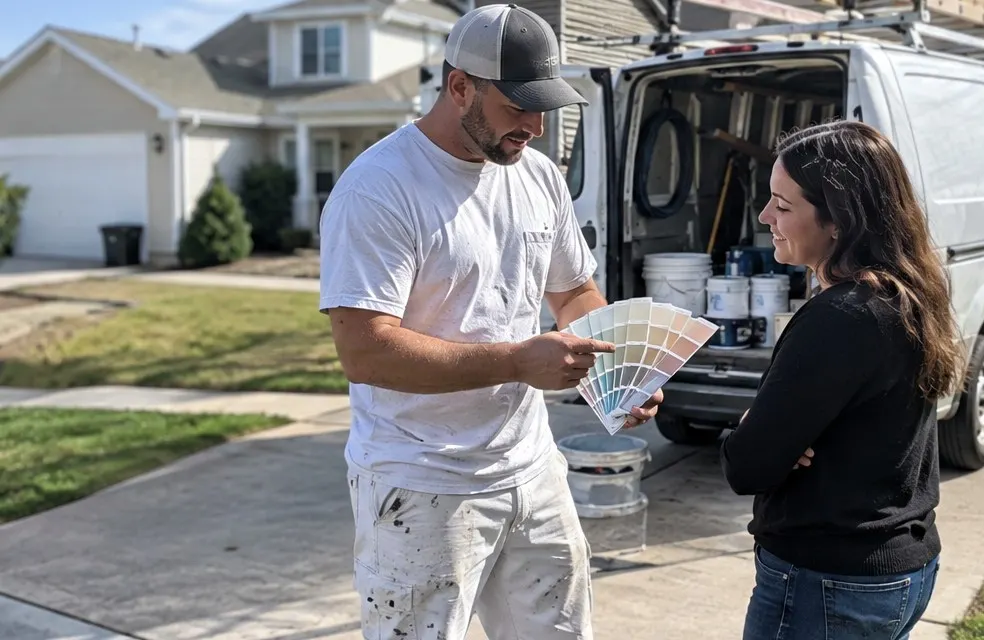
Now count the work behind 14 jobs. Say you close 1 in 3 estimates (an assumption: count yours for a month). That is 42 estimate visits. Each visit costs $45.11 in the example (an hour of your time plus 20 miles at the IRS rate of 76 cents/mile for July to December 2026), so 42 x $45.11 = $1,894.62 a month spent on visits, and 28 of them end with no job. Showing a price range on your site can cut the visits that were never going to book. Read painting estimates without driving out.
1. Google Business Profile
When a homeowner searches for a painter, Google's help page says local results are mainly based on relevance, distance, and popularity. Of those three, you control relevance and popularity:
- Relevance. Fill in every field: categories (Painter, plus any that fit your work), service area, hours, services and photos
- Distance. Set the service area honestly. You cannot move closer to a homeowner, so do not list towns you will not drive to
- Popularity. Google's page says prominence means how well-known a business is and that it is based on info like how many websites link to your business and how many reviews you have
Add photos of finished work every week or two. More in before and after photos and Google reviews.
2. Reviews after every job
Ask at the final walkthrough, when the customer is looking at fresh walls, and send the link by text the same day. Google's help page says you can ask customers to visit a Google link or scan a QR code. It also says that offering incentives, like free or discounted goods or services, in exchange for reviews is prohibited, so do not give a discount for a review. A script that works:
"Thanks for letting us paint your house. If you are happy with it, a short Google review helps other homeowners find us. Here is the link: [link]. If anything is not right, tell me and I will fix it first."
3. A website that answers the price question
Homeowners compare painters at night on their phone. The site that shows a range for "three bedrooms with ceilings" gets the call, and the one that says "call for a free estimate" waits. Use the arithmetic from the pricing guide to publish a range you can honor. See the painting contractor website checklist and the interior painting cost calculator.
4. A page for each job and each town
"Cabinet painting in Parkland" is a different search from "exterior painting in Coral Springs". A page for each combination you actually do, with photos from that town, is how a small company shows up for many searches instead of one. Do not make pages for towns you will not work in.
5. The neighbors of every exterior
An exterior job is a sign for a week. With the homeowner's OK, put a yard sign out, and check your city's rules on signs first. Leave a door hanger on the houses on either side, with a script like:
"We are painting the house at 4821 this week. If you are thinking about painting, ask us about a neighbor price this month."
The cost is small and the customers are easy to reach. Here is an example of what it costs, using assumptions you should replace: 300 door hangers printed for $120, 3 jobs booked from them. That is $40 a job. Compare that with the $472.65 the job leaves.
6. Realtors and property managers
Agents need homes painted before listing, and property managers need units turned between tenants. These are fast jobs, mostly empty rooms, and a good contact sends a job every month. Bring a one page price sheet built from your own numbers, answer the phone, and finish on the day you promised. Ask each one what they usually need and how fast they pay, and put that on your price.
7. Past customers
Every finished job is a list entry: name, phone, what you painted, the month. A short text in spring to past customers ("Booking exteriors for May. Want a price on the trim we talked about?") costs nothing. Ask each customer at the final walkthrough what they plan to do next, and write the answer next to their name. Most painters never send the text.
8. Answer every call
Painting leads are rarely loyal. A homeowner calls three painters and books the first one who calls back with a clear price. If you are on a ladder most of the day, read missed calls and painting answering services and the software guide.
9. Seasonal pushes
Book exteriors before the busy season starts, sell interiors when it is too wet or cold outside, and push cabinets when kitchen projects come up before the holidays. The months differ by region: see the painting business seasonal calendar.
10. Be careful with shared leads
Lead services sell the same homeowner to several painters, and you usually pay for each request. The price per lead depends on your area and the service: ask for the current price in writing, and ask how many other painters get the same request. Then do the sum. These are made up numbers to show it:
- You pay $40 a lead and win 1 in 5. Cost per job: 5 x $40 = $200
- You pay $40 a lead and win 1 in 10. Cost per job: 10 x $40 = $400
Compare each to what the job leaves. At $472.65 left from the example job, $400 a job keeps you almost nothing, and you still drove to the estimate. At the lower figure, a lead service can fill a gap in the calendar; as a steady source it makes you compete on price.
What do you say when the phone rings?
The call decides whether the visit happens. Ask the same five questions every time, write the answers down, and you can give a range before you drive anywhere:
- How many rooms, and are ceilings, trim or doors included?
- Is the house empty, or will furniture need to be moved?
- What condition are the walls in: peeling, stains, holes, a dark color going lighter?
- What year was the house built? (Before 1978 changes how you work: see the EPA page.)
- When do you want it done, and who else are you getting prices from?
Then say the range from your price sheet: "Three bedrooms with ceilings and trim usually runs between $1,700 and $2,100 on our price sheet. I would like to see the walls before I give you a firm number. Does Thursday at 4 work?" A customer who has heard a range and still books is a better visit than one who has not. These numbers come from the example job, so use your own.
What does a first month of work look like?
- Week 1: finish the Google profile, add ten photos, and write your price sheet from the pricing guide
- Week 2: text every past customer once, and ask two friends who own a home to introduce you
- Week 3: leave door hangers around your current exterior job, and call two realtors or property managers with your price sheet
- Week 4: count calls, visits and jobs by source, and drop the one that cost the most per job
Which source is worth your time?
Ask every caller "How did you hear about us?" and write it down. After three months, put the numbers in a table like this one. The figures are an example, not a promise.
| Source | Spent in 3 months | Jobs booked | Cost per job |
|---|---|---|---|
| Google Business Profile | $0 | 9 | $0 |
| Referrals and past customers | $0 | 7 | $0 |
| Door hangers around exteriors | $120 | 3 | $40 |
| Shared lead service | $1,200 | 6 | $200 |
Put your time and money where the closed jobs come from, not where the most calls come from. A source that brings many calls and few jobs costs you the visit price, $45.11, each time.
What does growth look like?
Most owner operators grow in steps: fill your own week, then hire one painter, then a second crew. The step that breaks companies is the office work that comes with it: more calls, more estimates, more invoices. Set up simple systems before the second crew, not after. That is what painting contractor software is for, and PaintPilot sets it up for a painting business: a website with prices, an AI receptionist for the calls you miss, and a review request after every job.
Frequently asked questions
What is the fastest way to get painting customers?
Tell everyone you know, set up a complete Google Business Profile with photos, ask for a review after every job, and leave door hangers on the houses around each exterior. Answer every call within minutes and show prices on your website.
Are paid lead services worth it for painters?
They can fill gaps, but the same lead goes to several painters, so you compete on price and speed. Do the sum: at $40 a lead and 1 win in 10, a job costs $400 in leads, against $472.65 left from the example job. Ask each service for its current price in writing.